These broadsides, produced between the 1890s and 1910s in Mexico, are a valuable insight into the cultural, political, social, and religious lives of people in and around Mexico City. Known as “ojas volantes” (literally “flying pages” or flyers), they combine current events with writings of popular Marian devotion, such as verse, theatrical works, prayers, and narratives of alleged miracles. Some are souvenirs from shrines and basilicas such as those dedicated to Our Lady of Guadalupe and Our Lady of San Juan de los Lagos. While often dramatized, these texts illustrate the connection between mass market printing, popular Marian devotion, and sociocultural developments in Mexico at the turn of the 20th century. This era in Mexico, known as the Porfiriato after Porfirio Díaz, brought rapid modernization to the country while also producing the conditions necessary for the Mexican Revolution, the effects of which rippled through political and social life for much of the remainder of the first half of the 20th century.
These ojas volantes were produced by the print shop of Antonio Vanegas Arroyo in Mexico City. Vanegas Arroyo’s printed works were distributed across Mexico, blending genres and bringing writings from poetry to current events to narratives of alleged miracles to a national audience. Vanagas Arroyo employed writers, typesetters, printers, and other specialized workers at his press. Among the most renowned engravers who contributed to Arroyo’s publications is Jose Guadalupe Posada, who is considered an important figure not only in printmaking, but in the broader cultural imagery of Mexico.
Posada’s “La Calavera Catrina”, an engraving of a skeleton with a wide-brimmed hat decorated with flowers and large feather plumes, is one of the most commonly associated images with Mexico’s Dia de los Muertos and has evolved to be a national symbol of Mexico. Like much of Posada’s work, it originally appeared in a Vanegas Arroyo oja volante. Many of the engravings in the broadsides here are the work of Posada, and the recycling of images or motifs across various broadsides show how Posada’s work was used to illustrate various prints created in Vanegas Arroyo’s shop.
-
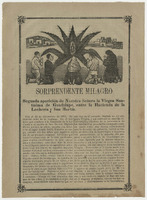 Sorprendente milagro. Segunda aparicion de Nuestra Senora la Virgen Santisima de Guadalupe, entre la Hacienda de la Lecheria y San Martin. Come, all believers, And adore with blind faith, The Queen of the Heavens Found in a maguey.
 -
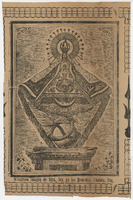 Milagrosa imagen de Nuestra Senora de los Remedios The recto has a full-page engraving of Our Lady of Los Remedios, with a large crown and mantle. The mantle drapes over the moon and heavens at her feet, resting on a snake wrapped around a sphere. The figure is atop a pedestal. The verso has an engraving depicting Jesus with a crown of thorns and tears of blood, flanked by angels. The text describes an elderly woman who must beg for food; she visits her son who is a rich man and asks for his help. He refuses cruelly, claiming that he owes nothing to her and sends her to work in his fields. His wife, a Catholic, warns him that they must honor their parents, and she offers to serve her mother-in-law. They mount horses to find her in the fields, but a massive flood strikes and washes away the man's farms, taking his wealth with it. The author entreats the reader to wear a scapular.
 -
 Loa dicha por una cocinera y un aguador en honor de Nuestra Senora del Rosario The recto contains an engraving of two figures, a woman on the left and a man on the right. The woman holds out her finger toward him. A large pot stands between them. The text is a loa, a short dramatic work that originated in Spain but that proliferated in Latin America. Loas entertained audiences waiting for the beginning of a festival or full length theatrical work. The dialogue of this work in between a cook and a water carrier. When a religious procession passes them, they stop their conversation and join in prayer for Our Lady of the Rosary.
 -
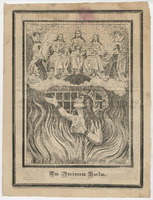 La anima sola The recto contains a full-page engraving with a woman in the foreground. Visible from the chest up and otherwise engulfed in flames and standing in front of a barred window, she gazes upwards and stretches an arm upward, showing the shackles around her wrists. Above this scene on a dais made of clouds, Mary and St. Joseph intercede. Three men in robes sitting on thrones represent the Holy Trinity, and they have triangular haloes. Angels attend to the scene. The text of the verso describes the experience of a soul in Purgatory and entreats the reader to consider such a fate. The bottom of the page is an invocation, asking the Holy Trinity to take pity on the reader's/writer's soul.
 -
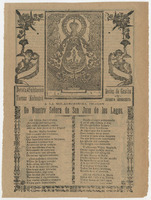 Devoto salutacion tiernas alabanzas accion de gracias y expresivo despedimento a la milagrosisima Imagen de Nuestra Senora de San Juan de las Lagos. An engraving of Our Lady of San Juan de los Lagos fills the top half of the recto. She is flanked by cherubs in flight and birds at the top left and right hand corners. On the verso an engraving in the shape of an upside-down T intersects the text and separates it into separate columns. Inside the shape is a scene of worshippers gathered for mass in front of the image of Our Lady of San Juan de los Lagos, with the image at the top of the shape framed by curtains and candles. At the bottom of the page at the left and right hand corners are two figures in religious garb holding oil lamps with with smoke streaming behind. The text is comprised of prayers for Our Lady of San Juan de los Lagos from the perspective of a pilgrim to the shrine. The prayer recounts devotees who were saved from shipwreck, poisoning, and fire by calling upon her, as well as punishment doled out and taken away from an impious man who mocked the Virgin and then expressed contrition. It is possibly a souvenir from the Basilica of Our Lady of San Juan de los Lagos.
 -
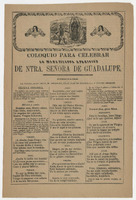 Coloquio para celebrar la maravillosa aparicion de Ntra. Senora de Guadalupe. An engraving on the top of the recto shows Juan Diego, with back turned, facing the apparition of Our Lady of Guadalupe with a hill in the background. Angels flank the scene, and all are encased in an elaborate border. The text is a short dramatization with dialogue, scenic directions, and a musical chorus. It details a conversation between Juan Diego and Our Lady of Guadalupe. It begins with the first apparition at Tepeyac Hill, with the Virgin instructing Juan Diego to go to the Archbishop of Mexico City, Juan de Zumarraga, to tell him to build a temple on the hill for her. The dialogue shifts to this conversation between Diego and Zumarraga, in which the archbishop does not believe the story and sends Diego away. In this dramatization, Juan Diego plans to go home but is taken by the arms back to the apparition. He explains the archbishop's disbelief, and she shows him the Castilian roses miraculously growing on Tepeyac Hill. In another conversation with the archbishop, Juan Diego presents the roses and tilma to validate the apparition.
 -
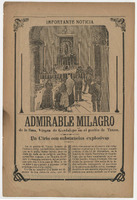 Admirable milagro de la Sma. Virgen de Guadalupe en el pueblo de Taxco: un cirio con substancias explosivas The recto has a large engraving depicting the interior of a church. The image of the Virgin of Guadalupe is surrounded by candles on the altar. In front of the altar, various figures stand with the backs turned. One group surrounds a man on his knees. The text describes the actions of a non-Catholic from Taxco resentful of the masses attending church. He brought two candles to the local church, including one filled with explosives. He brought them to the priest, asking that they be lit during the service on the feast of Our Lady of Guadalupe. The priest instructed the sacristan to burn them in advance to have them ready for the service. After lighting them, the sacristan felt a strong, inexplicable urge to put them out, later examining them and discovering the explosives. After notifying the priest, they thanked Our Lady of Guadalupe for instructing the sacristan to extinguish them, saving them from the explosion. The bottom of the verso contains a prayer of thanksgiving.
 -
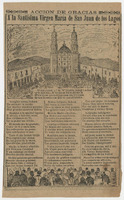 Accion de gracias a la Santisima Virgen Maria de San Juan de los Lagos The recto has an engraving of the Basilica of Our Lady of San Juan de los Lagos with Posada's signature on the bottom left corner. A large procession heading into the basilica spills out into the courtyard outside. The top of the verso carries an engraving from the inside of the basilica, with the image of the Virgin framed by curtains on the left and a clerical figure in biretta standing on a balcony on the right. A crowd stands facing both, with their backs visible. Text is placed so that it appears the crowd is saying: "Adios Virgen de los Lagos / Adios Reina de los cielos; / Adios Templo Sacrosanto / Dentro un ano nos veremos." (in English, "Goodbye Virgin of the Lakes / Goodbye Queen of Heaven; / Goodbye Sacred Temple / In a year we will see each other.") The text is comprised of prayers to Our Lady of San Juan de Los Lagos, naming specific regions of Mexico where pilgrims may have traveled from. Possibly a souvenir from the basilica of Our Lady of San Juan de los Lagos.
 -
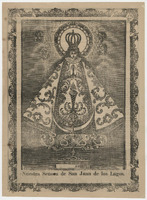 Nuestra Senora de San Juan de los Lagos The recto is a full-page engraving of Our Lady of San Juan de los Lagos with a highly decorative border, and the bottom half of the verso is an engraving of the Basilica of Our Lady of San Juan de los Lagos and its plaza. The text on the verso is comprised mostly of prayers from the point of view of a pilgrim to the Basilica of Our Lady of San Juan de los Lagos. It includes an act of contrition and praises for various miracles performed by the Virgin. It concludes with a short history of the basilica and its annual festival. Possibly a souvenir from the Basilica of Our Lady of San Juan de los Lagos.
 -
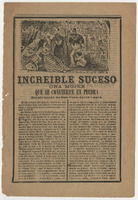 lncreible suceso una mujer que se convierte en piedra relato traido de San Juan de los Lagos Engraving at the top of the recto shows a group of four figures in the foreground. In the center a man and women are standing and have arms raised and facial expressions that show surprise. The man is wearing a hat and carries a walking stick; both figures are wearing cloaks. A child sits at the foot of the man and with his hands covering his face. To the left of these figures, a shoeless woman with her hair in disarray lays against a small boulder. The background of the scene shows a forested setting, and to the right a group of people with hats and walking sticks are shown walking from behind. The text of the broadside tells the story of Dona Eugenia Chavez, who recovers from a serious illness and in turn undertakes a pilgrimage between Nuevo Leon and the Basilica of Our Lady of San Juan de los Lagos barefoot. Accompanied by her husband, mother, and child, during the journey Eugenia is possessed by demons and begins to curse the difficult journey and express anger toward Our Lady of San Juan de los Lagos. Near the end of the journey, Eugenia takes shelter under a tree and expresses that she wishes she had never undertaken the pilgrimage. There is a large thunderclap and Eugenia is turned to stone, much to her family's terror. Eugenia's mother and husband beg her to repent and ask to the Virgin to have compassion. Eugenia refuses to repent and the family begs for mercy at the sanctuary of Our Lady of San Juan de los Lagos. Given the severity of Eugenia's actions, she remains in her stone form, much like Lot's wife, who was turned into a pillar of salt when she looked back at Sodom. The story concludes by noting that faith and contrition are the what is required by God and Mary; instructing readers that Eugenia could have quit her pilgrimage without cursing or blaspheming and all would have been settled. The bottom of the verso contains a retelling of Eugenia's story in verse.
 -
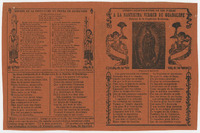 Tierno despedimento do los fieles a la Santisima Virgen de Guadalupe Patrona de la Republica Mexicana This broadside has two pages printed on the front and back, so that when folded there are four pages of text. It is printed on dark orange paper. On what would be the cover there is an engraving of Our Lady of Guadalupe flanked by cherubs on either side. Along what would be the inner fold are illustrations of the front and back of the Guadalupe medallion, and the text on the top half of the back cover is framed by figures in religious garb carrying oil lamps. The text is comprised of prayers for Our Lady of Guadalupe from the perspective of a pilgrim to the shrine, naming specific regions of Mexico where pilgrims may have traveled from. The text also highlights the indulgence granted to those wearing the medal of Guadalupe and relates the story of the coronation of the Virgin of Guadalupe and designation of the Basilica of the Virgin of Guadalupe in 1904 by decree of Pope Pius X. Possibly a souvenir from the Basilica of Our Lady of Guadalupe.
 -
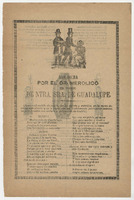 Loa dicha por el Dr. Mercolico en honor de Nuestra Senora de Guadalupe The recto has a small engraving of two men in top hats, one holding a box. The other reaches out to a figure with a bandaged head, holding their jaw. The verso has an engraving of the Virgin of Guadalupe flanked by figures in religious garb, holding oil lamps. The text is a loa, a short dramatic work that originated in Spain but that proliferated in Latin America. Loas entertained audiences waiting for the beginning of a festival or full length theatrical work. In this monologue, a dentist describes his craft. He is interrupted by a procession for Our Lady of Guadalupe, and begins to pray to the Virgin.